By Daisy Jai
Activist Digital Etiquette: Stewarding the Spaces That Hold Us
Activists are often encouraged to be disruptive. Sometimes that’s exactly what’s needed. History is full of moments where breaking convention exposed injustice. But not every space benefits from disruption. Some spaces exist because someone carefully cultivated them around a particular purpose. An activist started the group. Members joined because they trusted that conversations would remain focused. That trust might be worth respecting.
Digital communities are systems that seem to function best when participants understands what the space was created to do.
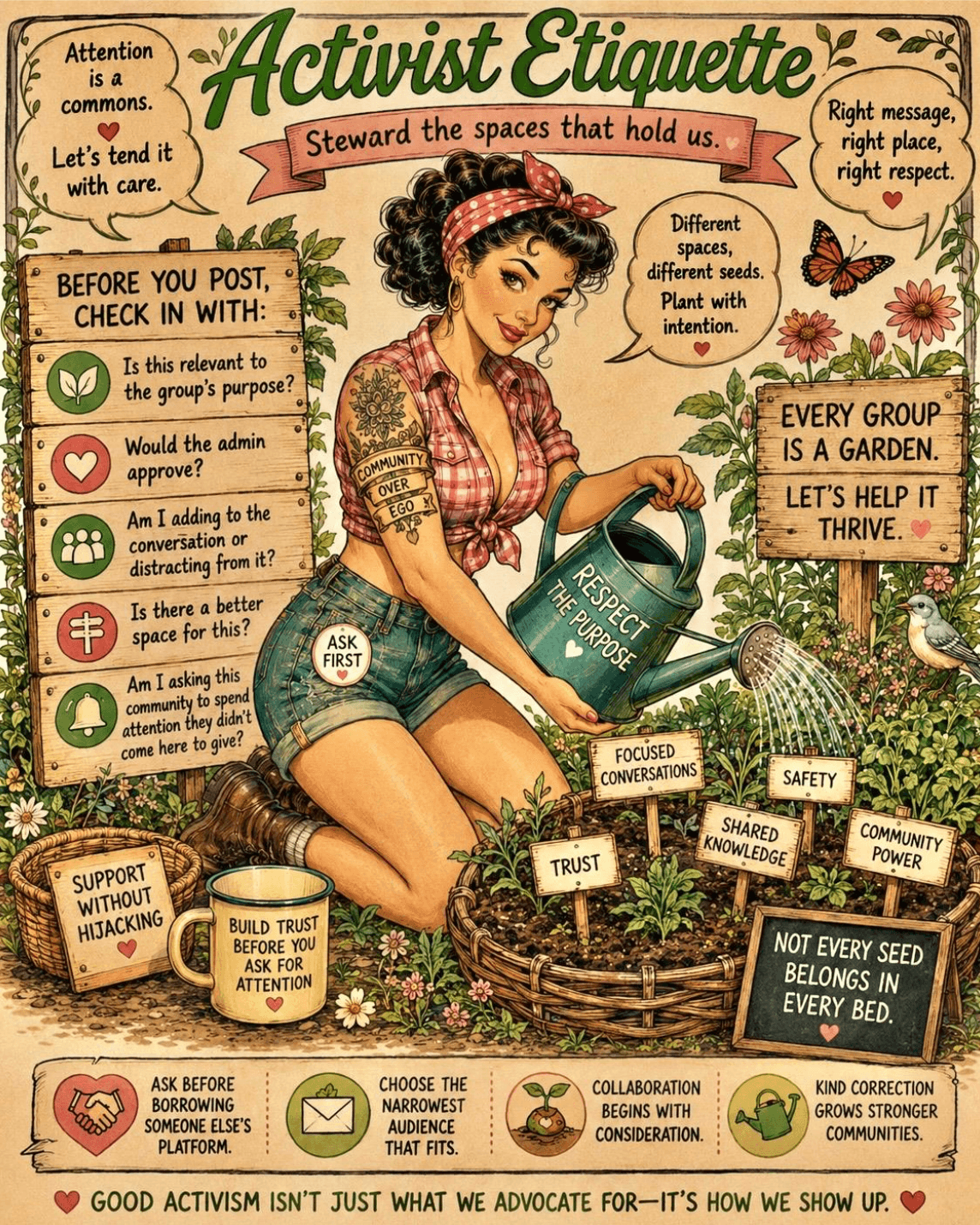
Before posting, we can ask a few questions:
* Is this relevant to the group’s stated purpose?
* Would the administrator likely approve if I asked first?
* Am I contributing to the conversation already happening, or redirecting it?
* Is there another group that’s actually a better home for this post?
* Am I asking this community to spend attention that they intentionally gathered for something else?
None of these questions are meant to discourage participation.
Sometimes another organization has a fundraiser, a petition, or an emergency worth supporting. That doesn’t automatically mean every group should become another distribution channel. Communities aren’t simply collections of email addresses. They have identities, cultures, and purposes. When we regularly post outside those purposes, several things can happen.
* The boundaries of the group become unclear.
* Members begin wondering what “belongs” there.
* More unrelated posts follow.
* Important conversations become harder to find.
* Some members eventually mute the group entirely.
Ironically, this makes it harder for the group’s original mission to reach people. Attention is finite.
Every notification asks for a small piece of someone’s day. Respecting that attention is one of the quiet forms of activism that rarely gets discussed.
This isn’t about rigid gatekeeping. It’s about stewardship. Sometimes the most respectful approach is simply asking an administrator first. Sometimes it’s posting in a more appropriate group. Sometimes it’s sending a handful of direct messages instead of broadcasting to hundreds of people. Those approaches often require a little more effort. However, they also preserve the integrity of the communities we all depend on. Good activism isn’t only about what we advocate for. It’s also about how we show up inside the communities that make advocacy possible.
Some principles we may like to adopt:
1. Honor the purpose of the space. Join communities for what they were created to do.
2. Treat attention as a shared resource. Every notification carries a cost.
3. Ask before borrowing someone else’s platform. Administrators are caretakers, not obstacles.
4. Choose the narrowest audience that fits. Don’t broadcast to 500 people if 20 is enough.
5. Correction over confrontation. When someone posts off topic, begin with curiosity and kindness rather than public shaming.
6. Build trust before asking for attention. Communities are relationships, not marketing channels.
Appreciate this post? Please consider supporting our work.